
wróć...About the space that became a cage. Meeting with Dr. Justyna Majewska
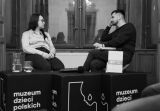
Another meeting from the series “Cała półka. Czytelnia o wojnie i dzieciach” (“The Whole Shelf: A Reading Room on War and Children”) is now behind us. At the Museum, we hosted Dr. Justyna Majewska, who is the author of an award-winning book titled “Mury i szczeliny. Przestrzenie getta warszawskiego” (“Walls and Crevices.Spaces of the Warsaw Ghetto”). It was an evening full of difficult questions about how urban architecture can become a tool of totalitarian oppression.
During the discussion, we examined the Warsaw Ghetto from sociological and cultural studies perspectives. Dr. Majewska movingly described the process by which ordinary streets and tenement houses were transformed into a “space of oppression.”
The main focus of reflection was the fate of the youngest inhabitants of the closed district.
“The ghetto walls did not only divide the city into two parts. Their purpose was to dehumanize those who were confined behind them,” it was stated during the meeting.
Dr. Justyna Majewska, who is the recipient of the Polityka History Award named after Marian Turski, shared with us not only her academic knowledge, but also her curatorial experience (including work at the POLIN Museum). Her research perspective allowed us to better understand the tragedy of the “least-heard victims” of the war: children for whom the ghetto was the only reality they had ever known.
“Cała półka” (“The Whole Shelf) series
The meeting took place as part of the Museum’s series dedicated to literature addressing the experiences of children during armed conflicts. Our mission is to restore the memory of those whose voices have been overlooked for years.
We thank all participants for their presence and for an inspiring discussion.